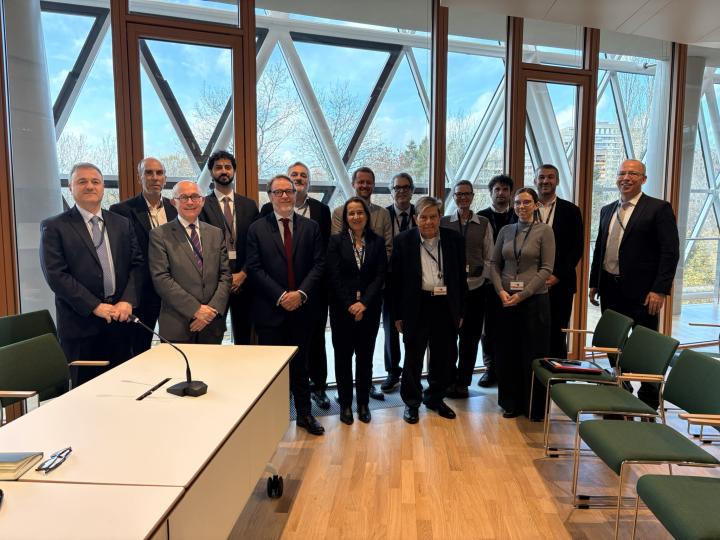
The European Federation of Engineering Consultancy Associations (EFCA)’s External Action Committee met with the European Investment Bank (EIB) and the European Federation of Management Consultancies Associations (FEACO) at the EIB headquarters in Luxembourg on 17 November for a full day of discussions on strategic procurement, benchmarking of international financial institutions (IFIs), and opportunities for consulting engineering companies in Europe and third countries.
A key discussion topic concerned the EIB's new strategic procurement model, which is approaching completion. The EIB is moving from a predominantly compliance-based model towards one that emphasises value for money, quality, sustainability, innovation and long-term project outcomes. Greater use of lifecycle costing, early market engagement and performance-based requirements will also be included. This direction strongly reflects arguments that EFCA has consistently raised in its work on procurement: procurement rules must give priority to quality and expertise instead of the lowest cost when selecting professional engineering services, and should support innovation and long-term value.
The exchange also highlighted the importance of earlier engagement with the market. Banks and project owners can thus better understand market capacity and the factors that can discourage EU companies from competing in tenders.
Participants subsequently discussed how the EIB's advisory services compare with other IFIs, such as the World Bank, the European Bank for Reconstruction and Development (EBRD) or the Asian Development Bank (ADB). The benchmarking exercise looked not only at the harmonisation potential between the IFIs practices, but also at specific improvements.
The EIB’s Advisory Services Framework Contract and the regional strategy developments were among the other agenda items addressed during the meeting.
The meeting builds on a well-established and fruitful dialogue with the EIB on improving procurement and project delivery. For EFCA, closer engagement between financial institutions and the consulting engineering sector is essential to ensure that project preparation and procurement make full use of engineering expertise, strengthen Europe’s partnerships, and translate EU investments into sustainable, resilient and high-quality infrastructure across the world.