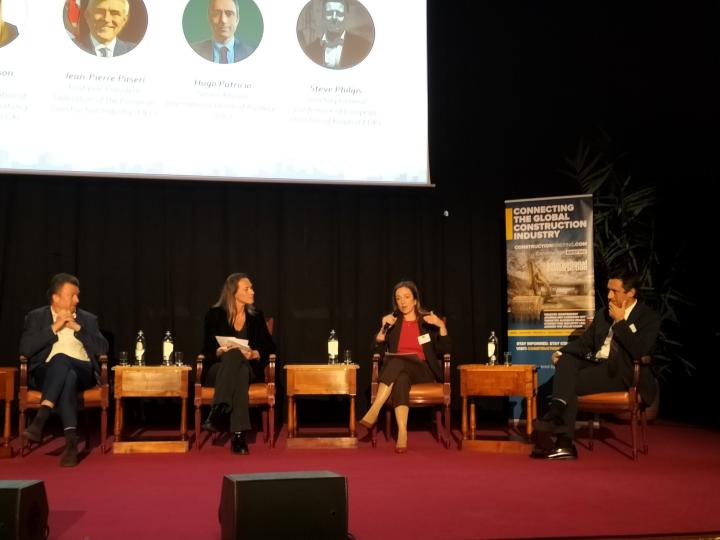
EFCA was represented at the highest level at Eurobridge 2026, held on 10 April in Brussels, with Ines Ferguson, our President, taking part in the political roundtable on the future priorities of EU transport policy.
The event, “Infrastructure for mobility: bridges, roads, tunnels”, brought together numerous public and private stakeholders – infrastructure authorities, contractors, engineers, academics, manufacturers, etc. – to discuss how the EU can strengthen the sustainability, resilience and performance of its transport networks.
The opening remarks focused on how EU transport and infrastructure policies can simultaneously respond to competitiveness, climate transition, security and resilience objectives. EFCA highlighted that infrastructure can no longer be viewed in isolation but must be planned as part of an interconnected system linking transport, energy and digital networks. Furthermore, resilience is not only about withstanding climate change, but also security threats, as we have recently seen in Europe and other parts of the world. In this context, European engineers play a strategic role in bringing systems thinking, technical integration and long‑term planning into investment decisions from the earliest stages. Introducing these considerations early in the process leads to lower project CAPEX and OPEX, as well as long-term sustainability and resilience.
Panellists also addressed the direction of future EU funding, including the potential expansion of the Connecting Europe Facility. Ines stressed that the TEN-T corridors should remain the focus, with the prioritisation of segments which contribute the most to military mobility or critical supply chains being essential. A fast-track mechanism to accelerate permits, clearances and approvals would speedup the delivery of these infrastructure projects.
Military mobility was a key discussion point, with EFCA underlining that transforming the TEN‑T into a truly dual‑use network introduces new regulatory, technical and operational challenges, since the military often operates with different standards and requirements.
The EFCA President also delivered the session’s closing remarks, underlining the critical role of EU public procurement in delivering quality infrastructure projects. There is a tremendous opportunity to change the preference to lowest price to a quality and innovation approach with the upcoming revision of the EU public procurement framework. In this context, EFCA’s main message was abundantly clear: “European systems built on the lowest price will not provide the speed, scale and standards that we need to remain competitive!”.
In conclusion, Eurobridge 2026 confirmed a growing consensus: achieving competitive, resilient, secure and future‑proof mobility networks will not only depend on funding levels, but on the planning, procurement, design and management of infrastructure investments in Europe — with engineering expertise playing a central role throughout project lifecycle.
During the event EFCA was represented by Ines Ferguson, its President (pictured above), Sue Arundale, its Director General, and Mihai Barcanescu, Policy Manager.